You’ve gotten a few quotes, maybe a glossy brochure or two, and now you’re staring at names that all sound roughly the same. Before you sign anything, the questions you ask matter more than the sales pitch you get.
Greenwich and Wilton homes tend to be large, detailed, and expensive to get wrong. A rushed decision on who holds the brush can mean redone trim, a color that doesn’t match the sample, or a crew that vanishes mid-project when a bigger job comes along.
The good news is that a few direct questions, asked before you sign, separate a solid local contractor from someone who just answered the phone fastest. None of them are awkward to ask, and any contractor worth hiring will answer them without hesitation.
In this article, you will learn about:
- The credentials you should actually verify
- Questions about the actual work
- Questions about cost and scheduling
- Red flags worth walking away from
Keep reading to build a short list of questions that protect your home, your budget, and your timeline before a single drop cloth goes down.
The credentials you should actually verify
Credentials sound like paperwork, but in Connecticut they’re the difference between a legitimate business and someone working out of a truck with no recourse if something goes wrong. A few minutes of checking saves a lot of regret later.
None of these questions require a contractor to hand over anything private. A registration number, an insurance certificate, and a work history are all things a legitimate business shares freely and often lists right on an estimate.
Insurance and liability coverage
Ask directly whether the contractor carries general liability insurance and workers’ compensation, and ask to see a certificate rather than just taking their word for it. Without both, you could be financially responsible if a worker gets hurt on your property or if paint damages something you didn’t expect.
A legitimate contractor will hand over a certificate without hesitation, and many will name their insurance carrier without being asked twice. Hesitation, vague answers, or a promise to “email it later” that never arrives is worth treating as a real warning sign, not an oversight.
When you do get a certificate, a few details are worth actually reading rather than just filing away:
- The policy dates, to confirm coverage is currently active, not expired.
- The coverage amount, which should be reasonable for the size of your project.
- Whether workers’ compensation is listed separately from general liability.
- Your own name or address, if the contractor offers to list you as an additional insured.
Homeowners in Stamford and Norwalk run into the same coverage questions as anyone in Greenwich or Wilton, since the underlying risk on a large residential job doesn’t change much from town to town.
Local licensing and registration in Connecticut
Every home improvement contractor doing paid work over $200 in Connecticut must be registered with the state, and that registration number is supposed to appear on every contract and advertisement. Asking for that number, and checking it yourself, takes only a few minutes.
The state agency that oversees this exists specifically to protect homeowners from unregistered operators. The Connecticut Department of Consumer Protection fields roughly 1,000 home improvement complaints a year statewide, including 265 in a recent year involving contractors who were never registered at all. A quick lookup before signing anything is one of the cheapest forms of protection available.
How long they’ve actually been in business?
A newer company isn’t automatically a bad choice, but longevity tells you something a brochure can’t: how the business handles a slow season, a bad review, or a callback years after the original job. Ask directly how long they’ve been operating under their current name.
Follow up by asking for a few references from projects similar in size to yours, ideally in Greenwich, Wilton, or a comparable nearby town. A contractor confident in their work will offer names without much prompting.
A short reference conversation tends to answer more than the sales pitch ever will:
- Did the crew show up when they said they would?
- Was the final result close to what was originally quoted?
- Would the homeowner hire the same crew again for a second project?
- Did anything come up mid-job, and how was it handled?
Homeowners in Fairfield or a similarly detailed, high-end market tend to ask these questions instinctively for other big-ticket hires, like a landscaper or a kitchen renovator. Painting deserves the same level of diligence.
Questions about the actual work
Once the credentials are confirmed, the next round of questions gets into how the job itself will actually run. This is where vague, feel-good answers separate from specific, confident ones.
A contractor who can describe their process in detail, step by step, is usually the same contractor who follows that process consistently on your job.
What prep work is included before paint goes on?
Prep work is invisible once the final coat goes on, which makes it tempting for a lower bidder to skip. Ask specifically what’s included: scraping, sanding, caulking, priming bare or repaired spots, and protecting floors, fixtures, and landscaping.
- Will they scrape and sand any peeling or flaking areas before priming?
- Are cracks, nail holes, and trim gaps caulked before the first coat?
- Is bare wood or drywall spot-primed, not just painted over directly?
- What gets covered or masked off, and is furniture moved for you or left in place?
A contractor who answers these in specific, concrete terms is describing a real process. One who says “we’ll take care of everything” without naming a single step is often planning to skip a few. Solid prep work is also what separates a repaint that holds up from one that starts showing cracks again within a year.
How many coats and what products they use?
Ask how many coats are included in the quoted price, and ask by name which paint line they plan to use. “Premium paint” is not an answer. A specific product line is.
This is also a good moment to ask about low-VOC options if odor or air quality is a concern for anyone in the household, and whether any color guidance is included in the estimate or billed separately. Both are reasonable things to ask about upfront rather than discovering mid-project.
Who’s actually on the crew?
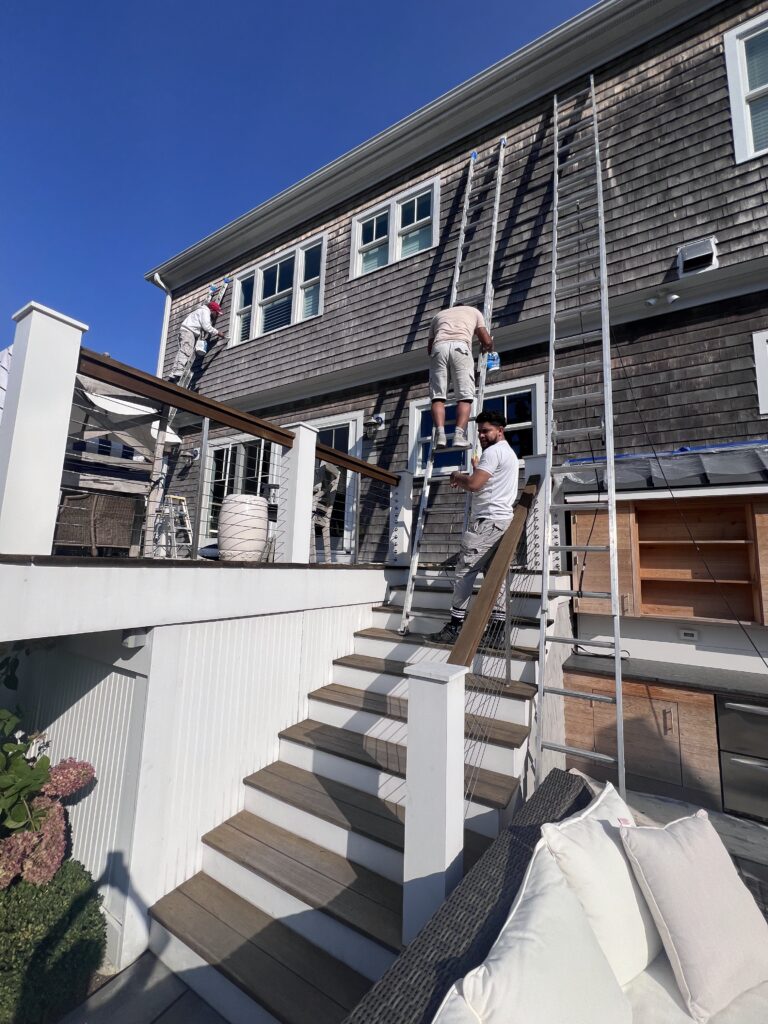
Some companies send the same experienced crew to every job. Others subcontract out to whoever is available that week, with quality that shifts from project to project. Ask directly whether the people on-site are employees or subcontractors, and whether the same crew stays for the whole project.
This matters more on a large or detailed home, where a rotating cast of unfamiliar workers makes it harder to hold anyone accountable for a mistake. A straightforward answer here, with specific names or a consistent lead, is a good sign, whether the job is interior work in Greenwich or an exterior project in Darien.
Questions about cost and scheduling
Cost and timeline questions are where a lot of homeowners get burned, not because a number was wrong, but because it was vague. Getting specifics in writing now prevents a disagreement later.
Two quotes that look similar on the surface can represent very different scopes of work, so the goal here is comparing apples to apples, not just picking the lowest number.
Why estimates can vary so much?
It’s common to get quotes that differ by hundreds or even thousands of dollars for what looks like the same job. Ask each contractor to walk through exactly what’s included, since quotes vary so much largely because of what’s quietly left out of the lower number.
Understanding rough interior cost drivers or exterior cost ranges before you start collecting quotes gives you a baseline to judge against, rather than just reacting to whichever number lands first.
What’s in writing versus what’s a verbal promise?
Everything that matters should be in the written contract: the scope of work, the products used, the number of coats, the payment schedule, and the estimated timeline. A verbal promise that “we’ll touch up anything you’re not happy with” means very little once the crew has moved on to the next job.
- Get the full scope of work in writing, not just a total dollar figure.
- Confirm the payment schedule, including what’s due upfront versus on completion.
- Ask what happens if the project runs longer than expected due to weather.
- Clarify what counts as a touch-up and for how long after completion.
A contractor who resists putting details in writing, or who pushes you to sign quickly without reading it carefully, is telling you something important about how disputes will go later.
Timeline and weather contingencies
Ask for a realistic start date and duration, and ask specifically what happens if weather pushes an exterior job back. A full crew working efficiently should be able to give you a fairly confident window, even if exact dates shift by a day or two.
For exterior work especially, ask how they sequence a multi-day job and what a realistic timeline actually looks like once you account for drying time between coats. A vague “we’ll get it done whenever” is a scheduling problem waiting to happen once your calendar depends on it.
Red flags worth walking away from
Most of the questions above are about confirming good signs. A few answers, or behaviors, are worth treating as reasons to walk away entirely, no matter how good the price looks.
Trusting your gut here is reasonable. A contractor who makes you uneasy before you’ve even signed anything rarely gets easier to work with once the job is underway.
Pressure to decide on the spot
A legitimate contractor understands that painting your home is a real financial decision and gives you time to compare quotes. Heavy pressure to sign today, especially paired with a “special discount” that expires immediately, is a classic pressure tactic rather than a genuine deal.
Take the time you need. A contractor confident in their pricing and their work doesn’t need urgency to close the sale.
No local references or portfolio
Ask for examples of recent work in your area, ideally homes in Greenwich, Wilton, or a nearby town like Stamford or Norwalk. A contractor with real local experience should be able to point to specific streets or neighborhoods without much digging.
- No photos of completed local projects, only generic stock-style images
- References that are out of state or impossible to verify
- Vague answers when asked how many jobs they’ve completed in your specific town
- No willingness to drive by a past project if you ask
A contractor genuinely established in Fairfield County usually has this information ready before you even ask.
Vague answers about warranty or touch-ups
Ask directly what happens if paint starts peeling, cracking, or fading within the first year or two. A specific, confident answer, even a modest one, is far more trustworthy than a vague “we stand behind our work” with no actual terms attached.
Get any warranty or touch-up policy in writing, including how long it lasts and what it actually covers. If a contractor can’t describe their own policy clearly when asked, it’s worth assuming there isn’t a real one behind the sales talk, whether you’re comparing budget-friendly options in Wilton or a larger project closer to reliable, established crews in Fairfield.
Conclusion
Hiring the right painting contractor in Greenwich or Wilton comes down to asking a handful of direct questions and paying attention to how confidently they get answered. Credentials, a clear process, honest pricing, and a real warranty policy are not too much to ask for on a project this size.
The homeowners who end up happiest with their paint job are usually the ones who asked a few uncomfortable questions upfront, not the ones who picked whoever called back first. A little friction before you sign saves a lot of frustration after the crew has already left.
If you’re comparing contractors for your own home, Greenhaus is happy to answer every question on this list directly, including our registration, insurance, and the actual crew who would be showing up at your door.